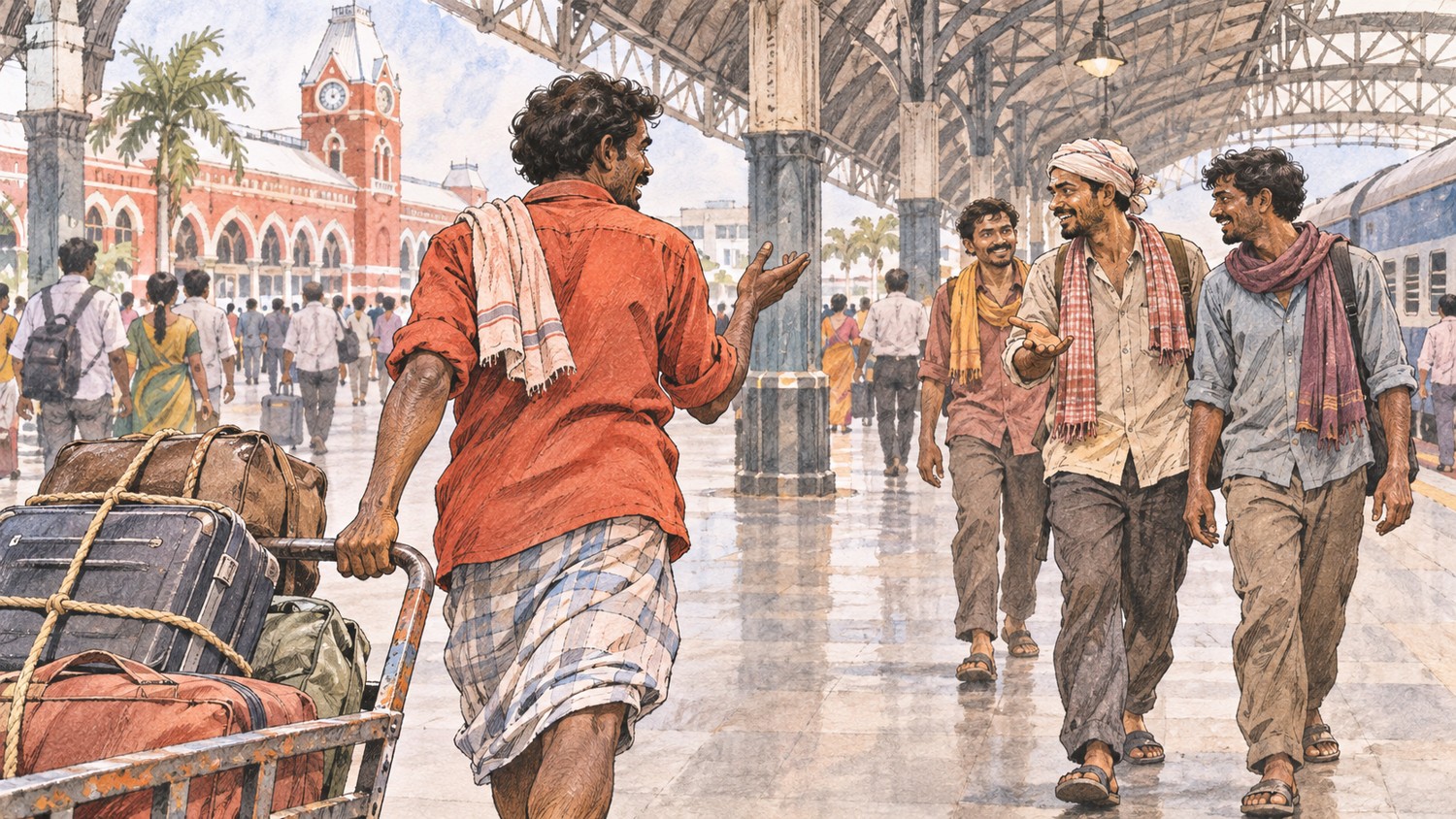
AI-generated illustration of the Chennai Central encounter.
At Chennai Central, I overheard a porter speaking Hindi. It was an ordinary exchange, and that was precisely what stayed with me. Here, in a state where generations had resisted the compulsory introduction of Hindi, the language had found a place in a working conversation.
I had always thought about language and migration from the point of view of the person who moves. You arrive in a new place, and you learn some of its language because you need to get by. At Chennai Central, I found myself wondering about the other side of that bargain. What happens when the people who stay begin to depend on the people who arrive?
Why workers make the journey
Tamil Nadu accounted for 14.99% of the people engaged in India’s registered factory sector in 2024–25. That gives a sense of the scale of the state’s industrial workforce. The wage figures help explain why someone might travel to join it. NITI Aayog’s estimates for urban unskilled labour in 2023–24 put the average daily wage at ₹637 in Tamil Nadu, ₹442 in Bihar and ₹401 in Odisha. These are state-level estimates. A worker deciding whether to move also has to weigh the wages actually offered, how steadily the work is available and what it costs to live away from home. [1–2]
Demography is part of the story, but it can take us only so far. The NFHS-5 put the fertility rate of both Tamil Nadu and Odisha at 1.8 children per woman. Yet Odisha was the largest source of workers in Tamil Nadu’s interstate migrant registration figures reported in August 2025. I find that comparison telling. To understand why someone from Odisha moves to Tamil Nadu, I would start with a more immediate question. What work can they find in each place, and who can help them get it? [3–4]
When workers arrive through networks
By August 2025, Tamil Nadu had recorded 12.17 lakh interstate workers in its registration database. Odisha accounted for about 2.89 lakh, followed by Bihar at 2.51 lakh, Jharkhand at 1.95 lakh and West Bengal at 1.91 lakh. Those four states accounted for roughly three quarters of registrations. The figures cover registered workers and tell us where they came from. They leave open the question of what languages people use once they arrive at work. [4–5]
A person looking for work far from home will often start with someone who knows the employer, the contractor or the town. A referral can answer practical questions that a job advertisement cannot. Will the work last? Where will I stay? Who do I speak to if my pay is short? Research on the textile and garment sectors in Tiruppur and Coimbatore documents the role labour intermediaries play in recruiting workers across long distances. [6]
What interests me is what happens after the recruitment. If the person who brings workers in is also the person who explains the wage terms, interprets a grievance or relays a supervisor’s instructions, both sides may come to depend on that person’s account of what was said. A supervisor who learns enough Hindi to check whether an instruction was understood gains a direct line to the worker. A migrant who learns enough Tamil to ask about a deduction gains a direct line to the supervisor. The value of those few words lies in what each person can now ask, hear and verify. That is where a wage decision made in one part of the country begins to change a conversation in another.
Looking through the Johari window
The Johari window helps me ask what a brief encounter makes visible and what I could easily miss. I’m looking at it from where I stood, as someone outside that working conversation.
- Open
- The porter and the people he was speaking to knew which language they were using. I could hear it too. Hindi was doing some practical work in that moment.
- What I bring to the scene
- I heard those few words against the history of Tamil Nadu’s resistance to compulsory Hindi. That history explains why the moment struck me. The people speaking may have been thinking only about the work in front of them.
- My blind spot
- The people doing the work know who usually switches languages, when they ask someone to interpret, and which questions are hard to ask directly. I cannot tell any of that from one exchange.
- What remains unknown
- How often does adaptation run both ways? Does it change who gets trained, who settles a dispute, or how much a workplace depends on a single intermediary? A station encounter can prompt those questions. Answering them takes time and evidence.
The distinction matters because hearing a language gain a place at work tells us little about how much power the people speaking it actually have.
A workforce can be essential while its workers remain vulnerable
The 2026 South India Interstate Migration Survey covered 1,824 respondents across 33 districts in Tamil Nadu, Karnataka and Kerala. Nearly 72% reported better living standards after migrating. At the same time, 86.4% had no written employment contract and 57.6% were paid in cash. I read those figures together. A worker can be better off for having moved and still have difficulty establishing what they were promised or challenging what they were paid. [7–8]
Those figures complicate what I heard at the station. A workplace can depend on migrant labour while the people doing the work still depend on a contractor or a co-worker to understand what was agreed. That dependence can run the other way as well. A supervisor may have to rely on the person who recruited the crew to tell him what the crew is saying. Once you depend on someone to translate every conversation, you also depend on them to decide what gets passed on.
Who has to learn whose language?
We usually expect the person who moves to learn the language of the place they move to. What stayed with me at Chennai Central was the possibility that the adjustment was running the other way too. When enough of the people you work alongside speak a different language, you have a reason to learn a little of theirs too. The wages that make it worth travelling to Tamil Nadu can, over time, change the language a person in Tamil Nadu finds worth learning.
That is what makes the moment striking in a state with a long history of resisting compulsory Hindi. Tamil Nadu’s Labour Department has itself used Hindi and Odia to reach migrant workers. [9] A porter using Hindi at work can still hold the same views about what should be taught in schools. Those choices answer different questions. One is about who gets to decide what people must learn. The other is about what people need to get through a working day together.
I heard only a few words at Chennai Central. But they made me think about something the migration figures alone cannot show. We count the people who move. We rarely notice how much the people who stay have to adapt.
Sources
- Annual Survey of Industries, 2024–25 — MoSPI, Table 2
- NITI Aayog — Urban daily wage estimates, Table 12
- Economic Survey — NFHS-5 fertility data, Table 8.18
- Tamil Nadu Labour Department registration figures — DT Next
- Coverage of the interstate worker register — The New Indian Express
- Labour recruitment in Tiruppur and Coimbatore — Journal of Contemporary Asia
- South India Interstate Migration Survey 2026 — IIMAD, UNFPA and IOM
- South India Interstate Migration Survey findings — Down To Earth
- Tamil Nadu Labour Department multilingual outreach — DT Next
Archive note
This essay was written and published through Vivek Studio.
This page is now the permanent canonical edition within Vivek Perspective.